

Dietary Supplements Market to Reach USD 447.6 Billion by 2035 as Personalized Nutrition Drives Growth
Dietary Supplements
Dietary Supplements Market is expanding as consumers seek personalized nutrition, wellness products, plant-based ingredients, and targeted health solutions.
Personalized nutrition and wellness innovation are reshaping consumer expectations and creating new opportunities across the dietary supplements industry.”
NEW YORK, NY, UNITED STATES, September 1, 2026 /EINPresswire.com/ -- The global dietary supplements market is entering a period of sustained expansion as consumers increasingly prioritize preventive wellness, nutritional balance, fitness, healthy aging, and personalized approaches to health management. Changing lifestyles, greater awareness of nutrition, expanding digital commerce, and growing interest in natural ingredients are influencing how consumers discover, evaluate, and purchase supplements.— Market Research Future (MRFR)
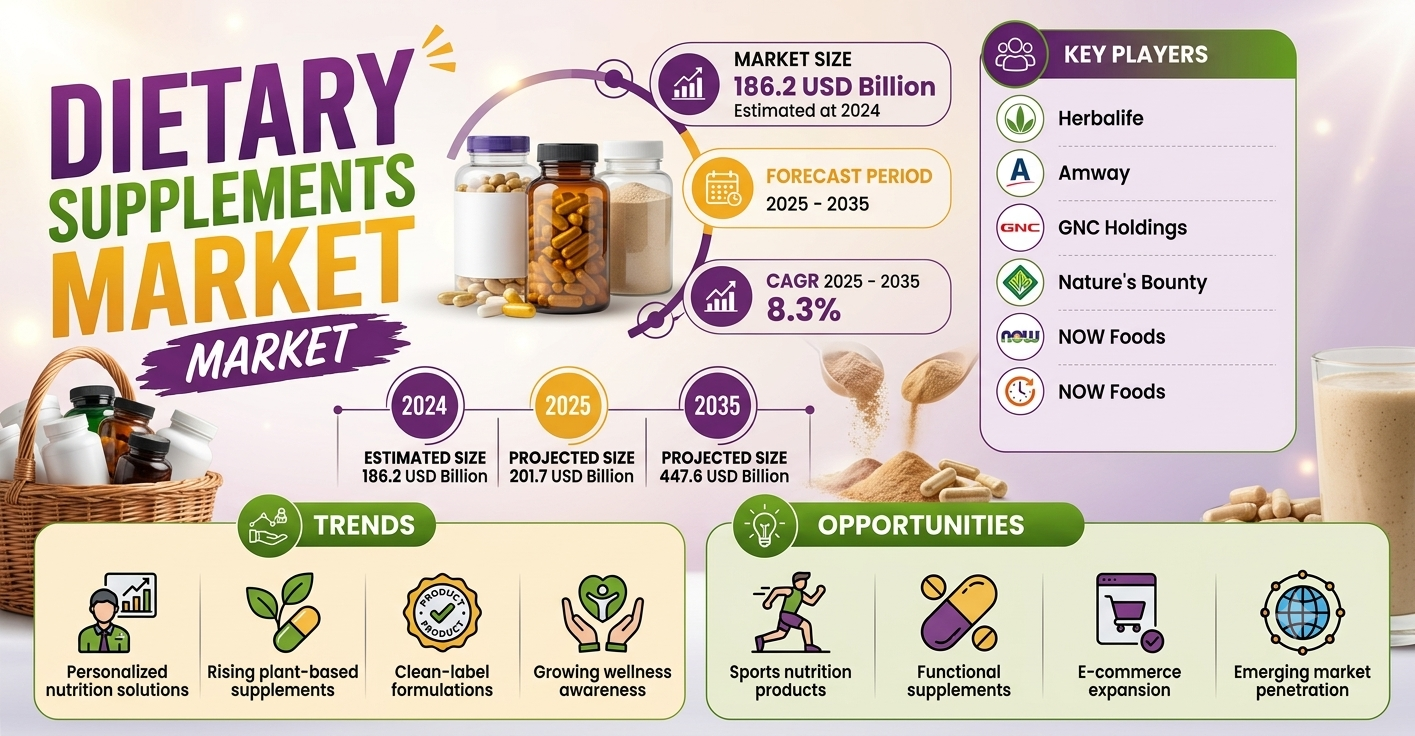
According to the latest analysis, the global Dietary Supplements Market was valued at USD 186.2 billion in 2024 and is projected to increase to USD 201.7 billion in 2025. The industry is anticipated to reach approximately USD 447.6 billion by 2035, registering a CAGR of 8.3% between 2025 and 2035. The study covers historical data from 2019 to 2024 and provides forecasts for 2025 through 2035.
Growing Wellness Awareness Reshapes Consumer Demand:
Dietary supplements are increasingly becoming part of everyday wellness routines rather than being used only to address nutritional gaps. Growing access to health information is encouraging consumers to take a more proactive approach to nutrition and personal well-being. This shift is supporting demand for vitamins, minerals, herbal supplements, protein-based products, and other nutritional formulations. Consumers are also becoming more selective about product ingredients, quality, sourcing, and transparency. Clean-label, plant-based, and recognizable ingredients are gaining attention as buyers seek products that align with their lifestyle preferences. At the same time, the growing focus on holistic wellness is broadening supplement applications across immunity, energy, digestive health, sports performance, healthy aging, weight management, and general nutritional support. Manufacturers are responding by creating more specialized products designed for different consumer needs and lifestyle goals. Personalization, convenient formats, and clear product communication are also becoming increasingly important. As wellness awareness continues to influence purchasing behavior, the Dietary Supplements Market is moving toward a more diversified product landscape focused on targeted nutrition, consumer preferences, and evolving health-conscious lifestyles.
Competitive Analysis:
The Dietary Supplements Market features a diverse competitive landscape comprising established manufacturers, specialized businesses, and emerging brands. Competition is increasingly focused on more than product availability, with companies emphasizing formulation innovation, ingredient quality, product transparency, digital engagement, distribution, and brand positioning.
Major Key Players:
▪️Herbalife (US)
▪️Amway (US)
▪️GNC Holdings (US)
▪️Nature's Bounty (US)
▪️NOW Foods (US)
▪️Garden of Life (US)
▪️NutraBio Labs (US)
▪️Optimum Nutrition (US)
▪️USANA Health Sciences (US)
Established players benefit from strong brand recognition and broad distribution networks, while smaller brands can compete through specialized formulations and targeted consumer segments. The expansion of e-commerce and digital marketing is also enabling niche businesses to reach wider audiences and build direct consumer relationships. As competition intensifies, companies are increasingly focusing on product differentiation, customer experience, innovation, and targeted wellness solutions to strengthen their market presence.
Personalized Nutrition Creates New Industry Opportunities:
One of the most important opportunities emerging across the industry is personalized nutrition. Consumers are increasingly looking for solutions that reflect individual dietary patterns, lifestyles, age groups, fitness objectives, and wellness priorities rather than relying solely on generalized supplementation.
Advances in digital health assessment, data analytics, health tracking, and consumer profiling are creating new possibilities for customization. Supplement providers can increasingly use information about dietary habits, lifestyle patterns, and personal goals to develop more targeted product recommendations.
Personalization also creates opportunities for subscription-based models and direct-to-consumer services. Instead of purchasing a generic product periodically, consumers may increasingly expect convenient programs that provide recommendations, recurring deliveries, and digitally supported wellness journeys.
The integration of technology could further strengthen this trend. Online assessments, mobile applications, connected health platforms, and smart packaging can improve consumer engagement while providing brands with opportunities to understand changing preferences.
According to the report, personalized nutrition represents a significant opportunity for the Dietary Supplements Market as consumers seek products aligned more closely with their individual needs.
Download Free Sample PDF Copy : – Access A Complimentary Copy of Our Report to Explore Its Content and Insights
https://www.marketresearchfuture.com/sample_request/1134
Natural and Plant-Based Ingredients Gain Attention:
Demand for natural ingredients is another major force influencing product development. Consumers who prioritize clean-label lifestyles are increasingly interested in botanical ingredients and plant-derived nutritional products.
Plant-based supplements are gaining attention because they connect several consumer priorities, including natural sourcing, wellness, sustainability, and dietary preferences. Manufacturers are responding with formulations designed for consumers seeking alternatives to conventional ingredients.
The movement toward natural products is also encouraging innovation in botanical extracts, plant proteins, herbal formulations, and other naturally sourced ingredients. Brands are increasingly emphasizing sourcing practices and ingredient transparency as part of their product positioning.
This trend is not limited to a particular consumer demographic. Younger wellness-focused shoppers, fitness enthusiasts, environmentally conscious consumers, and individuals following plant-oriented diets are contributing to demand for alternative formulations.
The increasing popularity of plant-based products is consequently creating opportunities for companies to differentiate themselves through formulation quality, sourcing transparency, packaging, and consumer education.
Preventive Wellness Becomes a Central Consumption Driver:
The shift toward preventive healthcare is significantly influencing supplement consumption. Rather than waiting for health concerns to emerge, consumers are increasingly taking proactive steps to maintain general wellness.
This behavioral change supports demand for products associated with everyday nutritional support, immunity, energy, healthy aging, digestive wellness, and other health priorities. The concept of maintaining wellness through consistent lifestyle choices has become increasingly important, particularly as consumers seek practical ways to complement balanced diets and active lifestyles.
An aging global population further reinforces this opportunity. Older consumers may have changing nutritional requirements and increasingly seek products that fit into healthy-aging routines. This is encouraging manufacturers to develop formulations and delivery formats designed around convenience and age-specific preferences.
At the same time, younger consumers are becoming more engaged with preventive wellness through fitness, nutrition tracking, and digital health platforms. This creates a broad consumer base extending across different age groups.
E-Commerce Transforms Supplement Purchasing:
Digital commerce is changing how consumers discover, compare, and purchase dietary supplements. Online retail provides access to a broad assortment of products, making it easier for consumers to research formulations, compare brands, read product information, and purchase products from home.
The growth of e-commerce is particularly important because supplement consumers often want access to specialized products that may not be available in conventional retail locations. Digital channels can provide a wider selection of formulations, including products designed for specific diets, lifestyles, and wellness objectives.
Online platforms also enable manufacturers to build direct relationships with consumers. Subscription services, personalized recommendations, educational content, loyalty programs, and digital customer engagement can all contribute to stronger brand relationships.
The expansion of online retail is therefore more than a change in distribution. It is helping reshape the complete consumer journey, from product discovery to purchase and post-purchase engagement.
Market Segmentation:
The Dietary Supplements Market can be segmented based on application, formulation type, target demographic, and distribution channel, reflecting diverse consumer needs and purchasing preferences.
By Application:
▪️Nutritional Support
▪️Weight Management
▪️Sports Nutrition
▪️General Wellness
By Formulation Type:
▪️Capsules
▪️Tablets
▪️Powders
▪️Liquids
By Target Demographic:
▪️Adults
▪️Seniors
▪️Athletes
▪️Children
By Distribution Channel:
▪️Online Retail
▪️Health Food Stores
▪️Pharmacies
▪️Supermarkets
Regional Landscape Reflects Diverse Consumer Priorities:
North America remains a major regional force in the global industry, supported by strong health awareness, established supplement distribution networks, e-commerce penetration, and consumer familiarity with vitamins, minerals, protein products, and herbal supplements. The United States represents the leading national market within the region, according to the report.
Europe presents another important environment, where consumers are increasingly interested in preventive wellness, natural ingredients, and product transparency. Regulatory requirements also play an important role in shaping product development and consumer confidence.
Asia-Pacific is attracting growing attention because of rising disposable incomes, expanding health awareness, increasing interest in preventive wellness, and improving digital access. China, Japan, Australia, and other markets across the region provide opportunities for both established international companies and local brands.
South America offers additional potential as consumer awareness surrounding nutrition and wellness develops. Meanwhile, the Middle East and Africa present emerging opportunities associated with urbanization, expanding middle-class populations, and increasing interest in health-oriented products.
The differences between regions mean that companies will need to consider local dietary preferences, purchasing behaviors, regulatory environments, and cultural expectations when developing expansion strategies.
Technology Becomes Increasingly Important:
Technology is expected to play a greater role throughout the supplement value chain. Manufacturers can use advanced analytical tools to support formulation development, while digital platforms can help consumers identify products that align with their preferences.
Smart packaging represents another area of opportunity. Digital features can potentially provide consumers with information about product usage, authenticity, sourcing, and engagement programs.
Artificial intelligence and data analytics may also support personalization by helping companies interpret consumer preferences and develop more targeted product recommendations. These technologies can create opportunities for brands to move toward more consumer-centric business models.
However, technology must complement—not replace—strong product quality, responsible communication, regulatory compliance, and transparent consumer information.
Sustainability Influences Product Development:
Sustainability is increasingly becoming part of the broader conversation surrounding dietary supplements. Consumers are paying greater attention to how ingredients are sourced, how products are packaged, and how brands address environmental considerations.
This creates opportunities for manufacturers to explore responsibly sourced ingredients, more efficient production processes, and packaging solutions designed to reduce unnecessary material use.
Sustainability can also become a differentiation factor for companies competing for environmentally conscious consumers. Brands that communicate sourcing and production practices clearly may be better positioned to establish credibility with increasingly informed audiences.
Challenges:
Despite favorable opportunities, the industry faces challenges. Consumers increasingly expect high standards of product quality, ingredient transparency, and reliable information. Manufacturers therefore need to maintain consistent quality throughout sourcing, production, testing, packaging, and distribution.
Regulatory requirements also differ between countries and regions. Companies expanding internationally must understand local rules concerning ingredients, labeling, product claims, advertising, and distribution.
Another challenge is the highly competitive nature of the industry. The growing number of brands and products can make it difficult for consumers to distinguish between alternatives. Companies need to establish credibility through transparent communication, product quality, responsible marketing, and meaningful innovation.
Maintaining consumer trust will remain particularly important as personalized nutrition and technology-enabled recommendations become more prominent.
Industry Developments:
2025: Asia-Pacific remained a major region for vitamins and dietary supplements, supported by rising health awareness and consumption.
2025: AI-powered personalized nutrition, plant-based ingredients, probiotics, omega-3s, and advanced delivery systems gained attention.
2025: Growing interest in cognitive health, healthy aging, gut health, immunity, and weight management shaped product innovation.
2025: Regulatory authorities increased scrutiny of supplements targeting minors, particularly weight-loss and muscle-building products.
2025: Automation, AI, smart packaging, and personalized manufacturing emerged as key industry innovations.
Future Outlook Through 2035:
The long-term outlook for the Dietary Supplements Market remains positive. The industry is projected to rise from USD 201.7 billion in 2025 to USD 447.6 billion by 2035, representing an 8.3% CAGR during 2025–2035.
Future development is likely to be shaped by the convergence of nutrition, technology, preventive wellness, fitness, healthy aging, and personalization. Consumers are expected to continue seeking products that fit naturally into their daily routines while providing greater convenience and relevance to their individual goals.
Personalized formulations could become increasingly important as digital health technologies mature. Companies that can combine reliable formulations with meaningful personalization may find new ways to strengthen consumer engagement.
Plant-based ingredients, clean-label positioning, convenient delivery formats, sports nutrition, digestive wellness, and healthy-aging products are also expected to remain important areas of product development.
The expansion of e-commerce will further support market accessibility, while emerging markets may create additional opportunities for brands capable of adapting products and communication strategies to local consumer preferences.
Frequently Asked Questions?
What is the projected size of the Dietary Supplements Market by 2035?
The global Dietary Supplements Market is projected to reach USD 447.6 billion by 2035, compared with USD 201.7 billion in 2025.
What is driving demand for dietary supplements?
Increasing health awareness, preventive wellness, interest in natural ingredients, healthy aging, fitness participation, product innovation, and expanding e-commerce are among the major factors supporting demand.
Why is personalized nutrition important for the industry?
Personalized nutrition enables products and recommendations to be aligned more closely with individual dietary habits, lifestyles, wellness goals, and preferences, creating new opportunities for product innovation and consumer engagement.
Which regions are covered by the market study?
The study covers North America, Europe, Asia-Pacific, South America, and the Middle East & Africa, providing a broad view of regional opportunities and industry development.
Browse More Reports:
Functional Mushroom Supplement Market:
https://www.marketresearchfuture.com/reports/functional-mushroom-supplement-market-33193
Creatine Supplement Market:
https://www.marketresearchfuture.com/reports/creatine-supplement-market-22932
Carnitine Supplement Market:
https://www.marketresearchfuture.com/reports/carnitine-supplement-market-28295
Ashwagandha Supplement Market:
https://www.marketresearchfuture.com/reports/ashwagandha-supplement-market-28284
Glucosamine Supplement Market:
https://www.marketresearchfuture.com/reports/glucosamine-supplement-market-35445
Market Research Future
Market Research Future
+1 855-661-4441
email us here
Legal Disclaimer:
EIN Presswire provides this news content "as is" without warranty of any kind. We do not accept any responsibility or liability for the accuracy, content, images, videos, licenses, completeness, legality, or reliability of the information contained in this article. If you have any complaints or copyright issues related to this article, kindly contact the author above.
